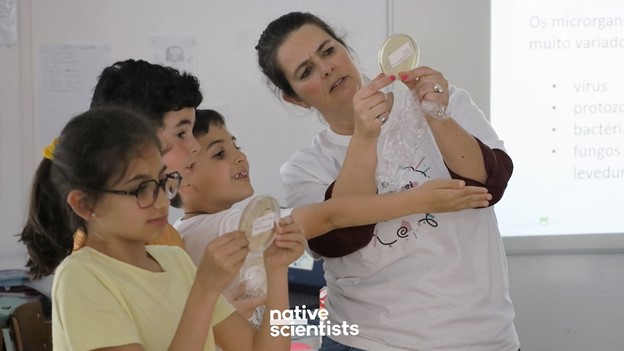
During this academic year, Cristina Esteves (CESAM/DBio) had the opportunity to return to the school where she completed her primary education in the Azores, through the “Scientist Returns to School” program.

This program is promoted by the organization “Native Scientists” and aims to bring scientists back to their childhood schools to conduct science workshops with children. Participants receive training in science communication for children, support to develop the workshops, and have travel and material expenses covered.

Regarding her experience in this initiative, Cristina Esteves mentions that “participating in a project like ‘Scientist Returns to School’ is doubly rewarding. Working with children is naturally challenging but also very rewarding: they are the most curious and insightful audience, with always very relevant questions that I often hadn’t thought about. But they are also an audience that (still) marvels at the wonders of science. On the other hand, returning to the village where I grew up brings back very good memories. I cannot fail to thank Native Scientists for the opportunity to participate in this project and especially Joana Bordalo for all her professionalism always accompanied by immense kindness, the Vila Franca do Campo Municipal Council, and the Regional Secretariat for Science and Technology, without which ‘returning to school’ would not have been possible.”

Since 2022, 42 scientists have returned to their schools, and the University of Aveiro has been a program partner since the 2022/23 academic year. Scientists interested in participating can register on the program’s website. To be eligible, one must conduct research in any field of knowledge and have completed primary education (1st cycle of basic education) in Portugal.

This program offers an opportunity to bring science closer to children and stimulate an interest in scientific subjects from an early age, contributing to a greater appreciation of scientific education in our country.

For more information about the program: [email protected]

Text based on: UA news with contributions from Cristina Esteves
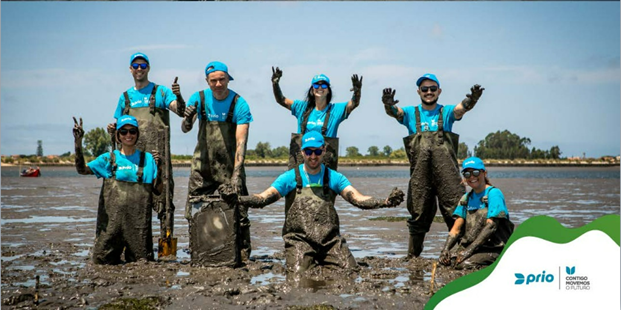
During the days of July 4th, 18th, 19th, and 20th, PRIO volunteers and the SEAREST-BC project team from the Center for Environmental and Marine Studies at the University of Aveiro (CESAM-UA) joined forces to undertake the important task of aiding in the restoration of seagrass meadows in the Ria de Aveiro.

In addition to preserving biodiversity, the mission aimed to offset the impact of human activity in the region through the concept of “blue carbon.”

This collaboration highlights the value of teamwork and joint efforts for the conservation of the marine environment and coastal areas, emphasizing the importance of active participation by all in the pursuit of sustainable solutions for the protection of our natural resources.

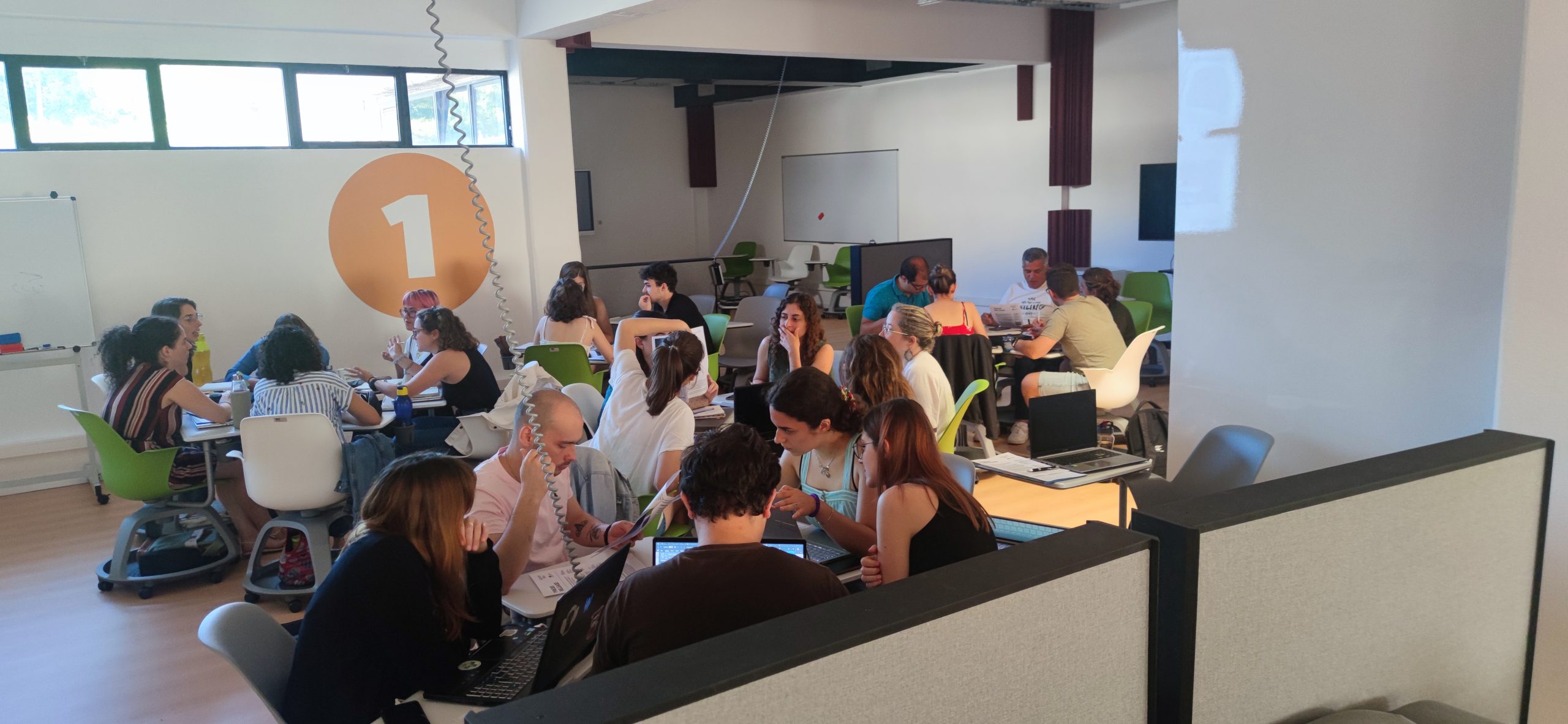
Between July 10th and 14th, the 7th edition of the Advanced Course on Scientific Writing and Communication took place at the University of Aveiro. The 2023 edition was jointly organized by the Center for Environmental and Marine Studies (CESAM), the Department of Biology at the University of Aveiro (DBIO), and the Faculty of Dental Medicine of the Portuguese Catholic University (UCP).

“This edition, in which we celebrate the tenth anniversary of the course, holds special significance: after 10 years, we realize that the training needs in science communication (in all its aspects) are growing, and our researchers are increasingly interested in better communicating the excellent science they develop not only to their peers but also to increasingly diverse audiences,” says Ana Cristina Esteves, one of the organizers of this advanced course.

Having filled up months before the deadline, the course had 25 participants from different cities and organizations. Over five days, these participants interacted with various experts and explored different tools to develop skills in both scientific writing and communication with the non-specialized public. According to Ana Sofia Duarte from the Portuguese Catholic University (UCP), also a member of the organizing team, “the course’s main goal is to respond to the needs felt by our researchers (from students in the early stages of training to doctoral researchers) to actively contribute to society. So, what we provide them with is a range of tools they can use to communicate their science. We include sessions on the more formal side of communication, such as writing scientific papers, to communication with non-specialized audiences.”

In the program component more focused on scientific writing, Isabel Henriques (University of Coimbra), Paula Fonseca (Polytechnic Institute of Viseu), Ana Sofia Duarte (UCP), Ana Cristina Esteves, and Joana Pereira (CESAM/DBIO) covered topics related to bibliometrics, writing, and reviewing scientific articles. In the component with a greater focus on oral communication and the use of visual elements, Marta Tacão (CESAM/DBIO), Sara Costa (UCP), Norberto Amaral (CULTIV), Manuel Valença (CESAM), Renata Pinto (PR INFLUENCER), and Miguel Leal (CESAM & Science Crunchers) discussed the importance of verbal and nonverbal communication, the specifics of the relationship between researchers and the national media ecosystem (journalists, media outlets, social networks, communication offices, and companies), as well as the production of scientific posters and graphic abstracts.

Two of the sessions in the program were also open to all interested parties: “Disinformation and Pseudoscience” by Diana Barbosa (New University of Lisbon) and the roundtable “Science Communication for Children and Youth” with Anna Moura (UCP), Inês Ferreira Guedes (Centro de Ciência Viva Lagos), Joana Bordalo (Native Scientists), Ana Hilário, and Sofia Ramalho (CESAM/DBIO).

As one of the students noted in the anonymous survey conducted at the end of the course, “I really enjoyed it. I wouldn’t change anything. The topics are very important and will certainly change the way I do things. I learned a lot.”

Given the interest and positive reception that this course has received from participants, “we are already preparing for the next edition: in addition to the basic topics that are always offered in this course, we always try to bring in new topics and new guests, making sure that some of the sessions are open to the academic community,” concludes Marta Tacão, a member of the organizing team for this advanced course.

Text by: CESAM in collaboration with Ana Cristina Esteves (CESAM/DBIO), Marta Tacão (CESAM/DBIO), and Ana Sofia Duarte (UCP).

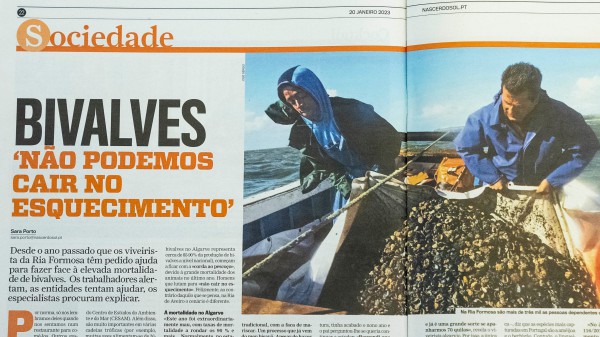
In the latest edition of Semanário Sol, our researcher Rosa Freitas (CESAM/DBIO) addresses bivalve mortality in Ria Formosa.

“(…) Monitoring marine toxins in bivalve mollusks is necessary (…) ‘Naturally, bivalves with toxins will need to develop defense strategies involving the expenditure, for example, of reserve energies that are not allocated to other processes such as growth or reproduction’ (…)”

Digital edition (subscriber-only) available here.

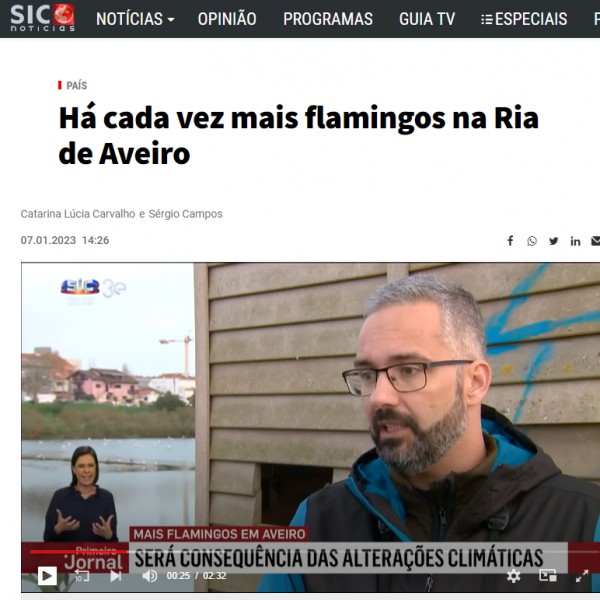
Our researcher, José Alves, discusses the growth of the Flamingo population in the Ria de Aveiro on the SIC’s Prime Time News.

You can watch the SIC report here.

You can also (re)read the column “Ask a Scientist from CESAM” here, where José Alves addresses the same topic.

On February 11th, the eighth edition of the International Day of Women and Girls in Science was celebrated, established by the United Nations.

A day that seeks to draw attention to the ongoing gender imbalance in access to education and scientific careers. And even though we strive to lead by example, boasting 56% female membership, we couldn’t let this day go unnoticed.

Given the international nature of the CESAM community, we took a pause in the work of four researchers, asking for their opinions on the level of access, in their countries of origin, that women have to education and scientific careers.

Video: https://youtu.be/1AeCm302Nm0

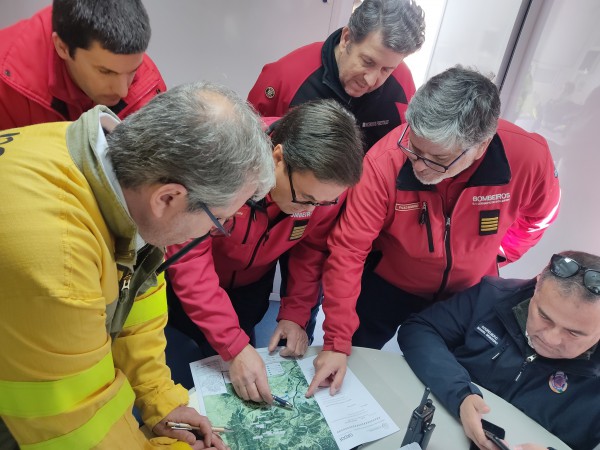
On the past days of January 30th and 31st, in the cross-border area between Cilleros, Spain, and Monfortinho, Portugal, the presentation of the decision-support digital platform “VESPRA” took place. This platform was developed as part of the Vulnerable Elements in Spain and Portugal and Risk Assessment project.

In an international consortium coordinated by the Spanish company Meteogrid, with the University of Aveiro, ADAI from the University of Coimbra, the Polytechnic University of Catalonia, the CIM of Beira Baixa, the Junta de Extremadura (Spain), and INFOEX, a LivEx exercise was conducted involving civil protection agents from both countries. They had the opportunity to test this new tool.

Over the course of two days, incidents of a cross-border rural fire were recreated, which resulted in a road accident involving a tanker carrying chlorine. Using the VESPRA platform, civil protection agents from both countries tested and defined a joint emergency response strategy for this international incident.

The VESPRA Platform was developed to analyze and assess the vulnerability of elements exposed to different hazards, such as rural fires, industrial accidents, including nuclear accidents, and episodes of extreme weather. The tool can provide decision support, both in the planning phase and in the emergency response phase for these types of incidents. This project is supported by the European Commission through the European Civil Protection Mechanism.

For more information: https://vespra.org/

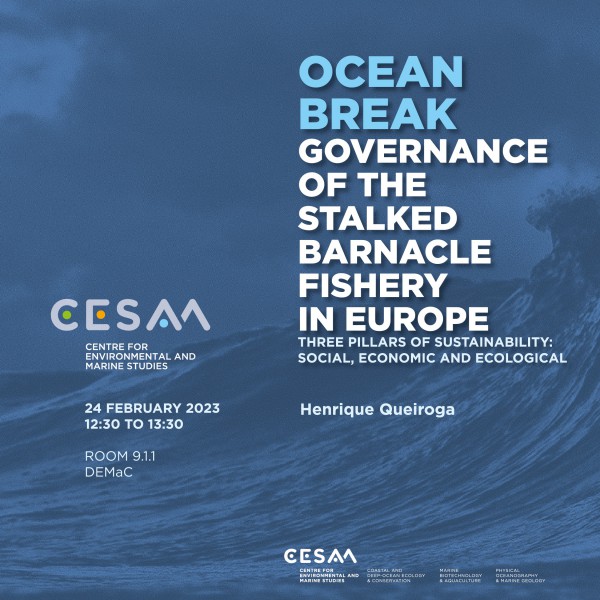
This edition of ‘Ocean Break,’ a series of seminars connected to marine research conducted at CESAM, will take place on February 24th (Friday), between 12:30 and 13:30, in Amphitheatre 9.1.1 (DEMaC). Admission is open to all interested parties.

Researcher Henrique Queiroga (CESAM/DBIO) will address the governance of barnacle fishing in Europe, focusing on its three pillars – social, economic, and ecological. European barnacle fishing (Pollicipes pollicipes) is a small-scale and highly specialized fishery that extends from southern Portugal to Brittany. In terms of its management, it can range from highly regulated territorial spaces for fishing to open access areas, varying from small patches (<1 km) to regional spatial scales (>100 km). Barnacles spend an extended larval period in the plankton.

According to Henrique Queiroga (CEAM/DBIO): “Our modeling work suggests that the management of P. pollicipes fishing requires an interactive and polycentric governance system across transregional, regional, and local scales. Diversifying the management portfolio will provide this important biological resource with a greater possibility of persistence.”

This seminar is a joint effort by three research groups at CESAM: CDEC (Ecology and Conservation of Coastal and Deep-Sea Ecosystems), MBA (Marine Biotechnology and Aquaculture), POMG (Physical Oceanography and Marine Geology).

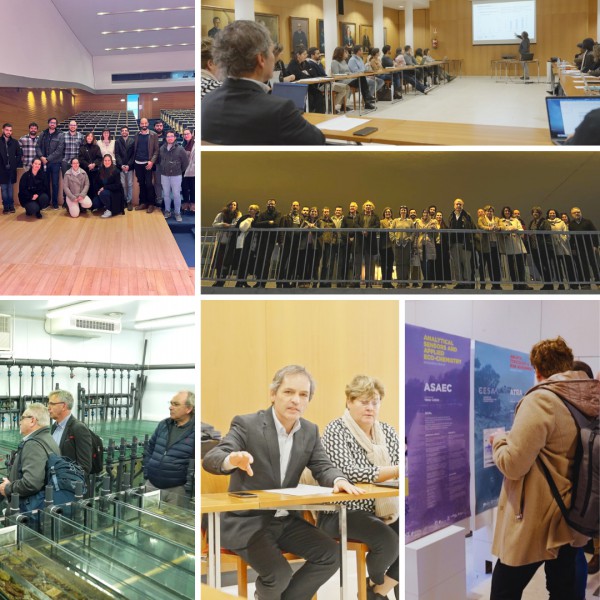
On February 9th and 10th, we welcomed the members of the External Monitoring Committee of CESAM, composed of Catherine Mouneyrac, Damià Barceló, Emilio Fernández Suárez, Fred Wrona, Lindsay Stringer, and Joseph M. Culp.

It was two days of intensive work and discussion, with a spirit of continuous improvement of our activities and operational processes.

Thank you to everyone involved!

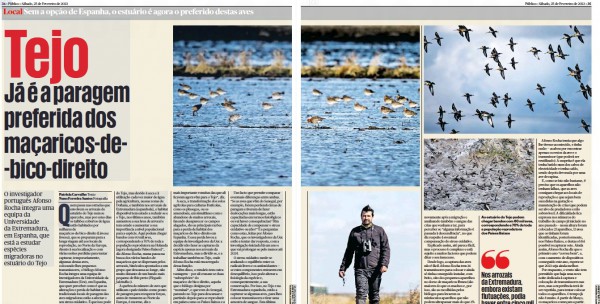
In the February 25, 2023 edition of the Público newspaper, researcher Afonso Rocha (CESAM/BIO) discusses his work with black-tailed godwits in the Tejo estuary. This work was conducted in collaboration with researchers from the University of Extremadura (Spain).

“Historically, the most important sites for the species as stopover areas during the migration route were Doñana, in Southern Spain, and in Portugal, the Tejo estuary. However, due to drought and the increasing use of water for agriculture in these Doñana areas and also in the rice fields of Extremadura [Spain], available habitat has been diminishing. In recent years, the Tejo estuary has also expanded its rice cultivation area, increasing its importance in terms of the species’ population,” the researcher stated in the article.

You can read the full article in the digital edition (for subscribers only) here.