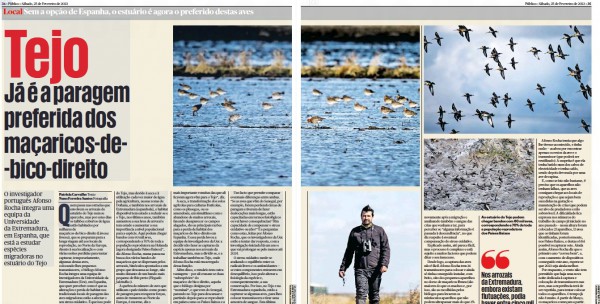
Na edição de 25 de fevereiro de 2023 do jornal Público, o investigador Afonso Rocha (CESAM/BIO) aborda o seu trabalho com os maçaricos-de-bico-direito no estuário do Tejo. Trabalho esse, em cooperação com investigadores da Universidade da Extremadura (Espanha)


Historicamente, os locais mais importantes para a espécie como zona de paragem, durante a rota de migração, eram Doñana, no Sul de Espanha, e em Portugal o estuário do Tejo, mas devido à seca e à utilização cada vez maior de água pela agricultura, nessas zonas de Doñana, e também nos arrozais da Extremadura [espanhola], o habitat disponível tem estado a reduzir-se e o Tejo, nos últimos anos, também aumentou a sua área de arrozal e tem estado a aumentar a sua importância a nível populacional para a espécie”, refere o investigador na reportagem.

Pode ler tudo na edição digital (só para assinantes) aqui.
RESTART Programme is a new FCT funding instrument, whose first Call opened in the 15th of February, created with the aim of promoting gender equality and equal opportunities through competitive funding of individual R&D projects, in all scientific fields, when carried out by researchers who have recently taken parental leave, including by adoption. Aligned with public policies in this area, RESTART also covers, with specific eligibility conditions, cases of shared parental leave, which privilege equality in the provision of care and the sharing of family responsibilities and duration of leave.

National, foreign and stateless researchers who meet the following requirements at the deadline for submission of applications may apply, with the commitment of the host institution:

  1. hold a doctoral degree;
  2. be a doctoral integrated member of an R&D unit, or have a contractual link with a State Laboratory;
  3. have taken parental leave, including adoption leave of 120 days or more, or have taken shared parental leave, including adoption leave of 72 days or more, within the last 12 months.

The deadlines referred to in point 3, and which appear in no. 2 of Notice of the Call have as reference the opening date of Call (February 15, 2023).

Deadline: 5pm Lisbon time on March 30, 2023.

More information HERE.

In 2023 edition, in addition to the applications in all scientific areas and with research work to be carried out in scientific and academic institutions, the call opens a specific line of application for PhD studentships in which work plans are partially carried out in one or more non-academic entities. In 2023, FCT will thus reinforce the connection between work plans developed in an academic environment and the business and social network, in a broad sense, which includes companies, public, social, health, cultural or other interface institutions.

The call is open from March 1st to 5:00 pm (Lisbon time) 31 March, 2023.

Supporting young group leaders in Europe and beyond

The EMBO Young Investigator Programme supports life scientists who have been group leaders for less than four years at the time of application in setting up their laboratories. Young Investigators receive financial support for networking for four years and benefit from training opportunities, support for their lab members and mentoring. 

Application deadline: 01 April 2023

More information HERE

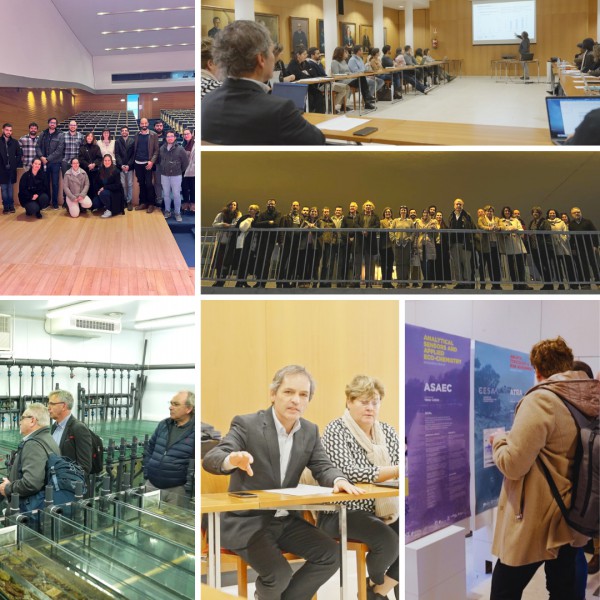
Nos dias 9 e 10 de fevereiro recebemos os elementos da Comissão Externa de Acompanhamento do CESAM composta por Catherine Mouneyrac, Damià Barceló, Emilio Fernández Suárez, Fred Wrona, Lindsay Stringer e Joseph M. Culp. 

Foram dois dias de intenso trabalho e discussão, num espírito de constante melhoria da nossa atividade e processos de atuação. 

Obrigado a todos os envolvidos!

Between January 16 and 20 of 2023, a new edition of the Advanced Course in Experimental Planning and Multivariable Data Analysis will take place, aimed mainly at students enrolled in doctoral programs at the University of Aveiro. The course is coordinated by Victor Quintino (CESAM/DBIO).

The course is delivered on-line, using Zoom sessions. The course follows a problem-solving approach, exploiting teaching and learning case studies. The teaching case studies present the baseline theoretical concepts and the software (PRIMER v7 with the add-on PERMANOVA+).

The learning case studies use real datasets and allow participants to apply the theoretical
concepts and acquire autonomy in the choice and workflow of the methods. PhD students that already have their own data sets should find enough time to exploit their data and discuss the methods.

For more information on the course syllabus and enrollment, access this link

The first external review of the thematic assessment of the underlying causes of biodiversity loss, determinants of transformative change and options for achieving the 2050 Vision for Biodiversity (transformative change assessment) was launched and is open until 17 March 2023.

By becoming a reviewer you’ll be involved in one of the most important phases in the IPBES assessment process.The IPBES seeks the widest possible participation and most diverse engagement of interested and qualified experts, including scientists, decision makers, practitioners and other knowledge holders from all relevant disciplines and backgrounds.This is vital to ensure the scientific quality, credibility and policy relevance of the assessment. Your expertise is crucial as your comments will help us to develop a better and more comprehensive assessment. The names of all expert reviewers will be acknowledged in the reports and the responses from the authors will be made available online once the assessment is approved.

More information: HERE

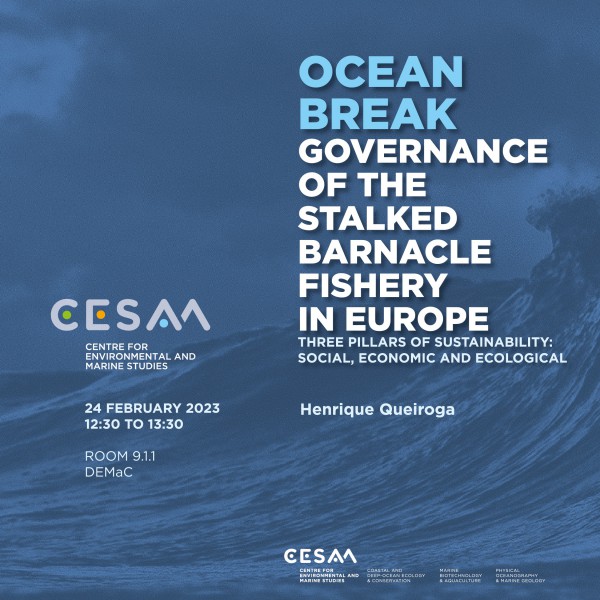
Esta edição do ‘Ocean Break’, série de seminários ligados à investigação sobre o mar feita no CESAM, acontece dia 24 de fevereiro (sexta-feira), entre as 12:30 e as 13:30 no anfiteatro 9.1.1 (DEMaC). A entrada é livre a todos os interessados.

O investigador Henrique Queiroga (CESAM/DBIO) irá abordar a governança da pesca de percebes na Europa, nos seus três pilares – social, económica e ecológica. A pesca do percebe europeu (Pollicipes pollicipes) é uma pesca de pequena escala e altamente especializada, que se estende desde o sul de Portugal até à Bretanha. Em termos da sua gestão, pode variar de espaços territoriais altamente regulamentados para pesca até acesso aberto e de espaços que variam de pequenas manchas (< 1 km) até escalas espaciais regionais (> 100 km). Sendo que os percebes passam um período larval prolongado no plâncton.

De acordo com Henrique Queiroga (CEAM/DBIO): “Os nossos trabalhos de modelação, sugerem que a gestão da pesca de P. pollicipes requer um sistema de governança interativo e policêntrico nas escalas transregional, regional e local. A diversificação do portfólio de gestão dará a este importante recurso biológico uma maior possibilidade de persistência.

Este seminário é uma organização conjunta entre três grupos de investigação do CESAM: CDEC (Ecologia e Conservação dos Ecossistemas Costeiros e de Mar Profundo), MBA (Biotecnologia Marinha e Aquacultura), POMG (Oceanografia Física e Geologia Marinha).

O programa RESTART é um novo instrumento de financiamento da FCT, cujo primeiro concurso abriu no dia 15 de fevereiro, criado com o objetivo de promover a igualdade de género e de oportunidades através do financiamento competitivo de projetos individuais de I&D, em todos os domínios científicos, quando realizados por investigadoras ou investigadores que tenham gozado recentemente de uma licença parental, incluindo por adoção. Alinhado com políticas públicas nesta área, o RESTART abrange ainda, com condições de elegibilidade específicas, os casos de licenças parentais partilhadas, as quais privilegiam a igualdade na prestação de cuidados e a partilha das responsabilidades familiares e durações de licença.

Podem candidatar-se, com o compromisso da instituição de acolhimento, investigadores nacionais, estrangeiros e apátridas que cumpram cumulativamente os seguintes requisitos à data-limite do período de submissão de candidaturas:

  1. ser detentor do grau de doutor;
  2. ser membro integrado doutorado de uma unidade de I&D, ou ter um vínculo contratual com um Laboratório de Estado;
  3. ter beneficiado, há menos de 12 meses, de uma licença parental, incluindo por adoção, de uma duração igual ou superior a 120 dias, ou ter beneficiado de uma licença parental partilhada, incluindo por adoção, de uma duração igual ou superior a 72 dias.

Os prazos referidos no ponto iii., e que constam no n.º 2 do Aviso de Abertura têm como referência a data de abertura do concurso (15 de fevereiro de 2023).

Deadline: 17h00, hora de Lisboa, do dia 30 de março de 2023.

Mais informações: AQUI.

The CBE JU Info Day 2023 allows you to gain insights into the upcoming call for project proposals 2023 and expand your network.

The info day will be streamed online, and its recording will be available on this page afterwards. You will be able to ask questions via an online tool during the event’s Q&A session and engage with other potential applicants on the CBE JU networking platform.

You need an EU Login account to register, you can create one at any time. Then register yourself HERE.